
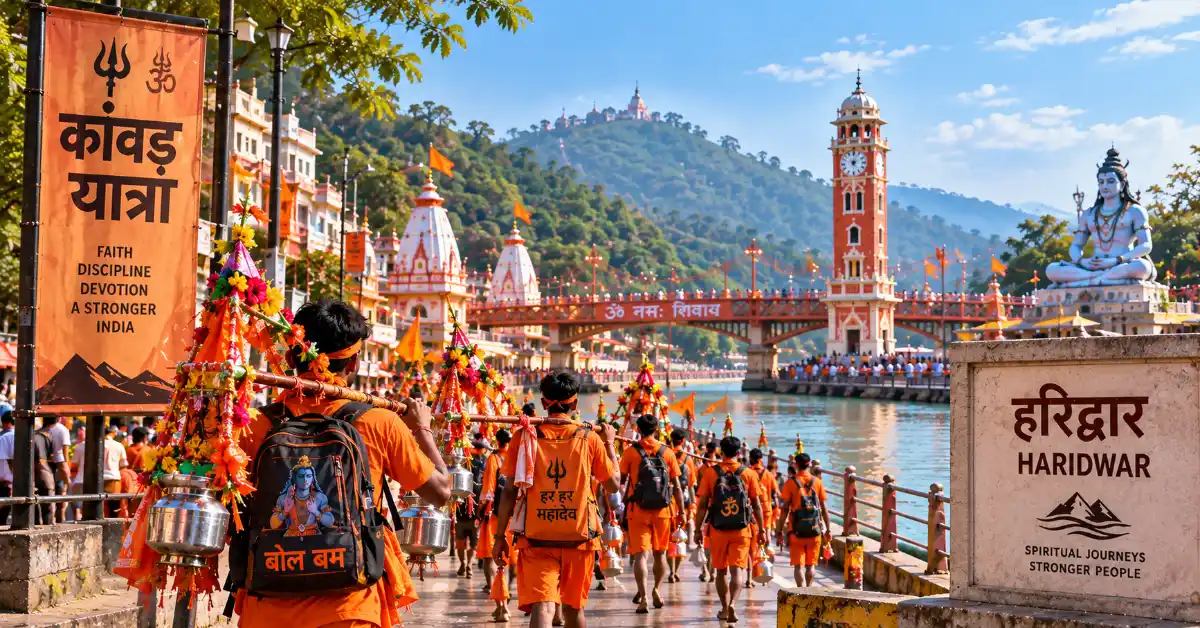
Quick Answer: Kanwar Yatra happens every year during Shravan (Sawan), the Hindu month falling roughly mid-July to mid-August, with exact dates shifting yearly on the lunar calendar. In 2026, it ran July 30 to August 11, drawing an estimated 4+ crore pilgrims to Haridwar alone. Roads on the Delhi-Meerut-Muzaffarnagar-Haridwar corridor see heavy walking traffic and vehicle bans in the final days. If you’re a leisure traveler, plan around these dates entirely, or use the train or Dehradun’s Jolly Grant Airport instead of driving in.
What Exactly Is the Kanwar Yatra?
Understanding haridwar kanwar yatra means starting with the ritual itself. It’s a pilgrimage, not a festival you watch from the sidelines.
Devotees called Kanwariyas walk to Haridwar, fill sealed pots with Ganga water at Har Ki Pauri, and carry them home on a bamboo pole called a kanwar. One rule is non-negotiable: the pots can’t touch the ground from the moment they’re filled until the water is offered to Shiva at a temple back home. That act of pouring is called Jalabhishek.
Rest stops along the route have hooks built specifically for this, so pilgrims can sleep without setting the kanwar down.
When Does Kanwar Yatra Actually Happen Each Year?
It follows the Hindu lunar calendar, so the exact Gregorian dates move year to year.
The yatra runs through Shravan (Sawan), typically landing somewhere between mid-July and late August. In 2026, it started July 30 and climaxed on Sawan Shivratri, August 11, the day most Kanwariyas perform Jalabhishek. The wider Sawan month continued until August 28.
If you’re planning a future trip, check the specific year’s dates a few months ahead rather than assuming last year’s calendar repeats exactly.
How Big Is the Crowd, Really?
Big enough to shut down highways.
By mid-yatra in 2025, over 2.5 crore Kanwariyas had already collected Ganga water and left Haridwar. For 2026, estimates ran past 4 crore pilgrims walking the route nationwide. The yatra has grown roughly four times over in the last 25 years, and infrastructure hasn’t kept pace with that growth.
This isn’t a crowd you navigate around. It’s a crowd that reshapes the entire region’s roads for two to three weeks.
What Happens to the Roads During Kanwar Yatra?
They stop functioning as normal roads.
The main route, NH-34, running Delhi through Meerut, Muzaffarnagar, and Roorkee into Haridwar, becomes the primary walking corridor. In 2026, heavy vehicles were restricted from July 30, and a full vehicle ban on the Delhi-Haridwar highway and Ganga Canal road ran from August 4 to 12. Local roads around Har Ki Pauri saw foot-traffic control and vehicle bans in the final days specifically.
Some Kanwariyas, known as Dak Kanwariyas, travel by vehicle instead of on foot, often in trucks fitted with loud sound systems, adding both traffic and noise on top of the walking crowds.
Should You Avoid Haridwar During Kanwar Yatra?
If you’re after a quiet, typical Haridwar trip, yes, avoid it.
This isn’t the window for a peaceful Ganga Aarti or an easy hotel booking. Roads jam, accommodation fills fast, and the entire rhythm of the city shifts around the pilgrimage rather than tourism.
That said, if you specifically want to witness one of the largest religious gatherings on earth, this is exactly the time to come, with the right expectations set beforehand.
Can You Still Reach Haridwar If You Need To Travel Then?
Yes, but not by driving the usual route.
The Panipat-Saharanpur road offers an alternate driving path that avoids the worst of the kanwar corridor. Trains and flights into Dehradun’s Jolly Grant Airport both work as reliable alternatives, since they skip the highway congestion entirely. If your trip has any flexibility, travel before the yatra starts or after it winds down in late August.
Do You Need Any Registration or ID During This Period?
If you’re not carrying a kanwar yourself, generally no formal registration.
In 2026, Kanwariyas were required to collect a free QR-coded wristband from Har Ki Pauri’s central camp or one of nine other authorized camps, scanned at checkpoints along the route. Spiritual tourists and regular travelers not participating in the yatra didn’t need this wristband, but carrying a photo ID was still recommended given the heightened security presence.
Quick Tips If You’re Traveling During This Window
- Check the current year’s exact Sawan dates a few months ahead, since they shift annually
- Book accommodation well before the peak days if you must be in Haridwar then
- Use rail or air travel instead of driving through the main corridor
- Expect noise, crowd density, and altered local routines, not just heavier-than-usual traffic
- If you’re simply passing through the region toward Rishikesh, Dehradun, or Mussoorie, reroute or reschedule rather than pushing through the corridor
FAQs
Should you avoid Haridwar during Kanwar Yatra? For a typical relaxed visit, yes. Roads jam, hotels fill quickly, and the city’s rhythm shifts entirely around the pilgrimage. It’s only worth visiting during this window if witnessing the yatra itself is the goal.
What are the biggest haridwar in july travel tips to know? Expect vehicle bans on the main Delhi-Haridwar corridor in the final week before Sawan Shivratri, book accommodation early if travel is unavoidable, and consider rail or air travel instead of driving.
How bad is the kanwar yatra crowd and traffic exactly? Severe. Tens of millions of pilgrims travel the route nationwide, with heavy vehicles restricted for over two weeks and a full vehicle ban on key highways during the final days before the peak ritual.
Do Kanwar Yatra dates change every year? Yes. The yatra follows the Hindu lunar month of Shravan, so exact Gregorian dates shift annually, generally falling somewhere between mid-July and late August.