
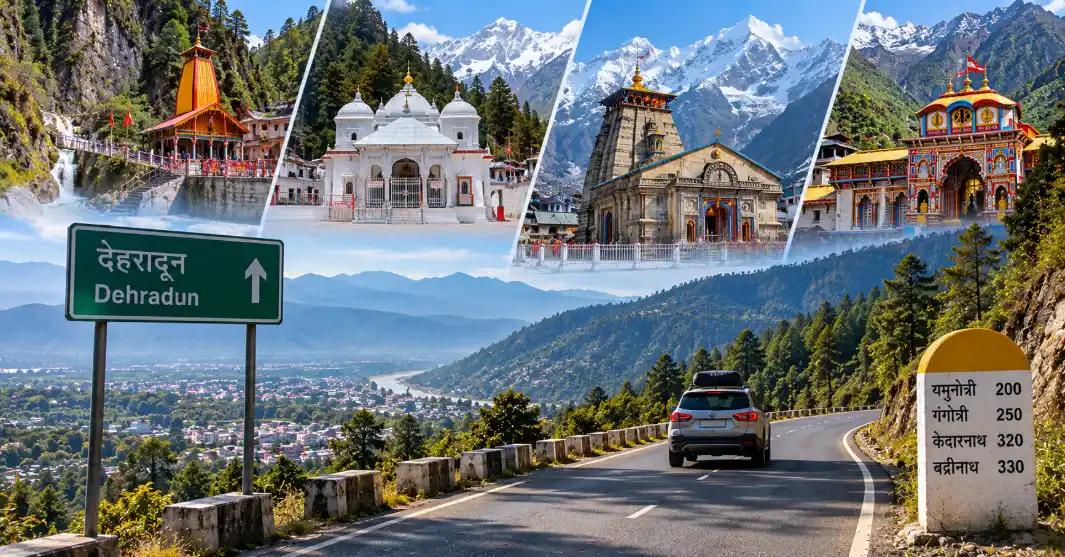
A dehradun char dham road trip typically takes 10 to 12 days covering all four shrines, Yamunotri, Gangotri, Kedarnath, and Badrinath, though the exact duration depends heavily on your pace and how much buffer time you build in for mountain weather. Here’s how the route actually breaks down.
The Route Order
The char dham yatra route from dehradun follows a sequence nearly every source agrees on, and it’s not arbitrary. You go Yamunotri, then Gangotri, then Kedarnath, then Badrinath, moving roughly west to east across the Garhwal Himalayas rather than backtracking between shrines.
| Shrine | Base Town | Distance from Dehradun (approx.) |
|---|---|---|
| Yamunotri | Barkot | ~170-200 km |
| Gangotri | Uttarkashi | ~250-280 km |
| Kedarnath | Guptkashi/Sonprayag | ~220-240 km |
| Badrinath | Joshimath | ~300-320 km |
Total dehradun char dham distance for the full circuit runs somewhere between 1,300 and 1,600 km depending on the exact stops and return path you take, sources genuinely differ on this, so treat it as a working range rather than an exact figure.
Day-by-Day Breakdown
Days 1-3: Dehradun to Yamunotri and back to Barkot/Uttarkashi The journey starts by heading toward Barkot, the base for Yamunotri. From Barkot, a shorter trek or pony ride gets you to the temple itself, dedicated to Goddess Yamuna.
Days 4-5: Gangotri From Yamunotri’s base, the route continues to Uttarkashi and on to Gangotri, marking the origin point of the Ganga and one of the more accessible dhams by road.
Days 6-8: Kedarnath This is usually the most demanding leg. You’ll travel to Guptkashi or Sonprayag, then either trek 16-18 km to Kedarnath or take a helicopter. Kedarnath is among the 12 Jyotirlingas, so this stop carries particular significance for many pilgrims.
Days 9-10: Badrinath The final shrine, reached via Joshimath. Unlike Kedarnath, Badrinath is fully road-accessible, no trekking required, which makes it a comparatively easier close to the circuit.
Days 11-12 (if included): Return to Dehradun or Haridwar The return leg often passes through Rudraprayag and Devprayag, where the Alaknanda and Bhagirathi rivers meet, a scenic and spiritually significant stop worth building into your final day.
Some faster itineraries compress this into 8-9 days, while family groups traveling at a gentler pace often stretch it to 12-14 days. If you’re traveling with elderly family members or young children, the slower end of that range is worth planning for.
Registration and Permits
Registration is mandatory for every pilgrim on the Char Dham Yatra, completed online through the Tourist Care Uttarakhand portal, ideally weeks before you travel. For 2026, private and commercial vehicles coming from outside Uttarakhand also need specific permits, a Green Card for environmental and safety compliance, and a Trip Card that tracks vehicle movement and passenger details. Offline registration counters typically open at major transit hubs including Dehradun, Haridwar, and Rishikesh a few weeks before the season begins, so check current dates before you travel since these can shift year to year.
Should You Drive, Take a Bus, or Fly Part of the Way?
- Private car or taxi: Most flexible, lets you set your own pace and stop where you want
- Bus (Uttarakhand Transport Corporation): Budget-friendly, with direct services toward Sonprayag for the Kedarnath leg
- Helicopter for Kedarnath: Cuts a full day of trekking down to a short flight, booked only through the official IRCTC HeliYatra portal
- Luxury helicopter charter for Badrinath: Available from Dehradun’s Sahastradhara Helipad for pilgrims who want to skip road travel entirely, though this is a premium option well above standard road or bus costs
Best Time to Go
May to June and September to October are generally considered the safest windows, with manageable weather and more stable road conditions. Monsoon months, especially late June through August, bring a real risk of landslides and road closures across all four routes, and mountain roads here can close with little warning during heavy rain, so this stretch is best avoided if your schedule allows any flexibility.
Bringing It Together
Any char dham itinerary by road rewards patience more than speed. Follow the Yamunotri-Gangotri-Kedarnath-Badrinath sequence, register well ahead of your travel dates, and build in a couple of buffer days for weather, since mountain roads rarely run exactly on schedule. Whether you complete it in a tight 8 days or a relaxed 12, the route itself, and the confluence stops along the way, are as much a part of the journey as the four shrines themselves.
FAQs
How many days does a Char Dham road trip from Dehradun take? Most itineraries run 10 to 12 days, though faster trips can be done in 8-9 days and slower, family-paced trips sometimes stretch to 12-14 days.
What is the correct order to visit the Char Dham shrines? The standard sequence is Yamunotri, then Gangotri, then Kedarnath, then Badrinath, following a roughly west-to-east path across the Garhwal Himalayas.
Is registration required for the Char Dham Yatra? Yes, registration is mandatory for every pilgrim and should be completed online well in advance. Vehicles from outside Uttarakhand also need specific permits.
What is the best time for a Char Dham road trip? May to June and September to October offer the most stable weather. Monsoon months, particularly late June through August, carry real landslide and road closure risk.