
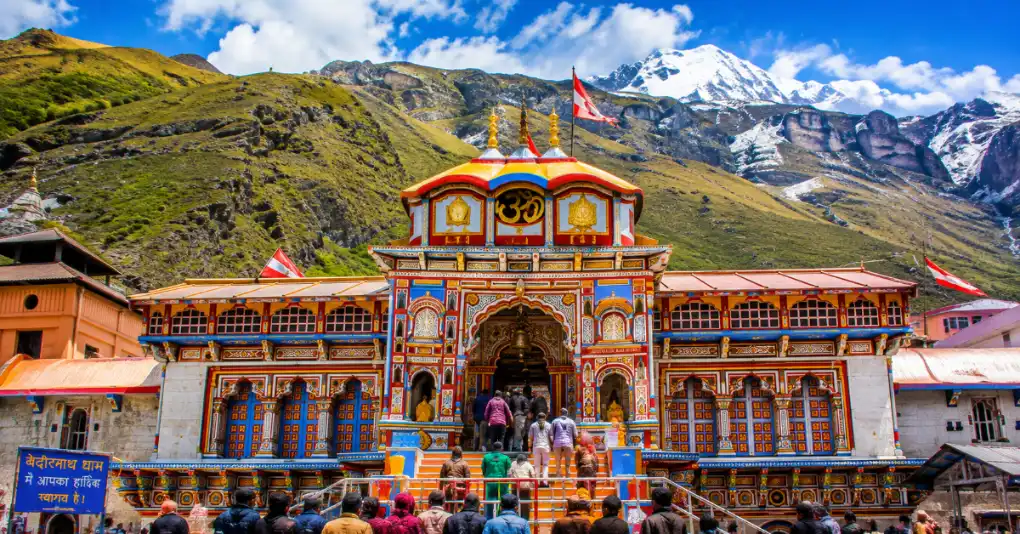
Of the four Char Dham shrines, Badrinath is the one you can actually drive to. No trek, no pony, no helicopter required, the road runs right up to the temple gates.
That single fact makes Badrinath the most accessible dham of the four, and it’s why so many elderly pilgrims and families choose it even when they skip the others. Here’s what you need to know about the temple’s history, its daily rhythm, and how to get there.
Badrinath Temple History
Badrinath temple history traces back to a legend still told by priests today. According to tradition, Lord Vishnu once meditated at this exact spot, deep in penance. Goddess Lakshmi, wanting to shield him from the harsh Himalayan cold, took the form of a badri tree, a wild berry, to stand guard over him. That’s where the name Badrinath comes from, “lord of the berry tree.”
The temple that stands today, built from wood and stone rather than carved stone alone, sits on the banks of the Alaknanda River, framed by the Nar and Narayan mountain ranges. It’s one of the holiest sites in Vaishnavism, and it anchors the final stop of the traditional Char Dham circuit.
Badrinath Temple Timings
Badrinath temple timings follow a fixed daily rhythm, and it’s worth understanding before you plan your visit.
| Session | Time |
|---|---|
| Mangala Aarti (morning) | 4:30–5:00 AM |
| General darshan | After Mangala Aarti until noon |
| Midday closure | 12:00–3:00 PM |
| Evening darshan reopens | 3:00 PM |
| Sandhya Aarti | 6:00–7:00 PM |
| Temple closes | Around 9:00 PM |
That midday break isn’t arbitrary. It’s when priests perform internal rituals, prepare offerings, and let the deity rest, according to temple tradition. Plan your visit around it rather than showing up right at noon expecting the doors open.
Timings shift slightly through the season and on festival days, so it’s worth confirming locally on arrival rather than relying purely on a fixed schedule.
When Does It Open Each Year
Badrinath follows a strict seasonal calendar tied to the Hindu lunar calendar. It opens around Akshaya Tritiya each spring and closes near Bhai Dooj after Diwali, staying open roughly six to seven months total.
The badrinath temple opening date for 2026 was April 23. During the winter closure, the deity is symbolically moved to the Narasimha Temple in Joshimath, about 64 km away, where worship continues on a smaller scale until the doors reopen the following year.
How to Reach Badrinath
Figuring out how to reach Badrinath is simpler than most Char Dham planning, since the road runs all the way to the temple, getting there is mostly about picking your starting point and settling in for a long, scenic drive.
- By air: Nearest airport is Jolly Grant, Dehradun, roughly 310–330 km from Badrinath
- By train: Nearest railheads are Rishikesh (295–300 km) and Haridwar (315–324 km)
- By road: The full drive from Haridwar or Rishikesh takes 10 to 14 hours, passing through Devprayag, Rudraprayag, Karnaprayag, Chamoli, and Joshimath
- By helicopter: Seasonal services fly from Dehradun, cutting the trip to under an hour when weather cooperates
Most pilgrims break the journey with an overnight stop in Joshimath, both to rest and to acclimatize before Badrinath’s higher altitude. It’s not required, but the altitude jump can feel abrupt if you skip it.
Worth a Stop Nearby
A few spots near the temple are worth the extra hour or two if you have the time.
- Tapt Kund: A natural hot spring where pilgrims traditionally bathe before darshan
- Mana Village: The last inhabited village before the India-China border, just 3 km beyond the temple
- Vasudhara Falls: A scenic waterfall a short walk past Mana Village
A Few Practical Tips
Arrive early for the calmer morning darshan window, before the midday crowds build. The evening session, especially around Sandhya Aarti, draws the biggest queues of the day.
Carry warm clothing regardless of the month. Even in peak summer, evenings at this altitude turn genuinely cold once the sun drops behind the peaks.
If you’re combining Badrinath with the rest of the Char Dham circuit, budget 10 to 12 days for a full road trip, or closer to 5 to 6 days if you’re flying between shrines by helicopter.
Bringing It Together
Badrinath’s biggest advantage is also its simplest: you can drive there. No physical strain, no permit for a trek, just a long, beautiful road through the Garhwal Himalayas. Plan around the temple’s open season, respect the midday break, and give yourself time in Joshimath to acclimatize before the final stretch.
FAQs
What are Badrinath temple’s darshan timings? Morning darshan runs from around 4:30 AM to noon, the temple closes for a midday break until 3 PM, then reopens for evening darshan until around 9 PM.
What is the history of Badrinath temple? Tradition holds that Lord Vishnu meditated here, and Goddess Lakshmi took the form of a badri berry tree to protect him from the cold, giving the temple its name.
When does Badrinath open in 2026? The temple opened on April 23, 2026, following the traditional Akshaya Tritiya calendar, and closes near Bhai Dooj in November.
How far is Badrinath from Haridwar? Roughly 315 to 324 km, a drive of about 10 to 14 hours depending on road conditions and stops along the way.
Is Badrinath accessible without trekking? Yes. Unlike Kedarnath, the road runs directly to the temple, making it the most accessible of the four Char Dham shrines.