
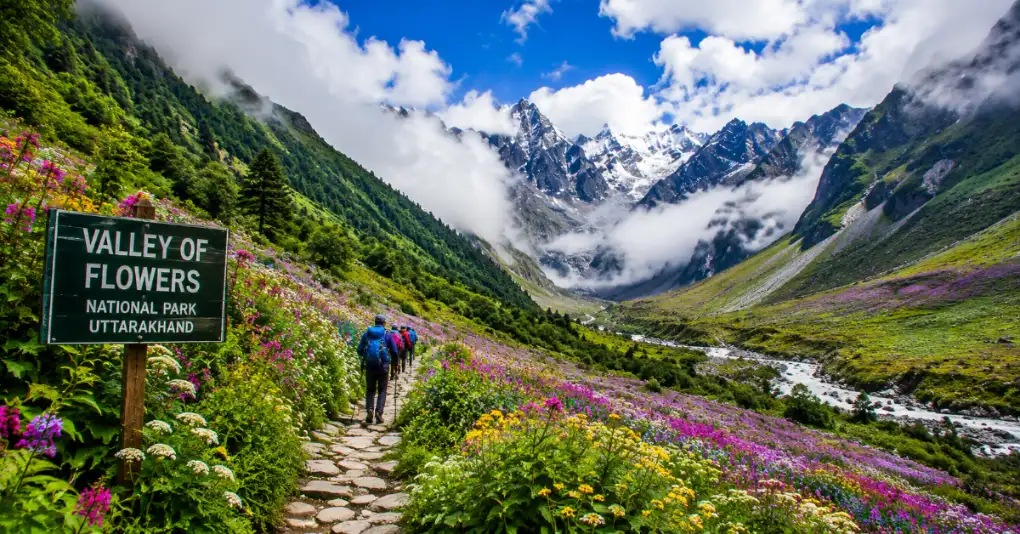
Try picturing this. A huge open valley, high in the mountains, and instead of grass and rocks, the entire ground is covered in flowers. Not a patch here and there. An entire valley, painted in every color you can think of, with snow-capped peaks standing guard around it.
That’s the Valley of Flowers, sitting inside Chamoli district in Uttarakhand. Photos genuinely don’t do it justice. You have to walk in yourself to get why people talk about it the way they do.
What This Trek Actually Feels Like
The walk isn’t quick. It takes days, and honestly, that’s part of what makes it mean something. You’re not just showing up for a photo. You’re earning the view.
Along the way you’ll pass through forest, cross small bridges over rushing water, watch the trees thin out as you climb. Your legs get tired. Your breathing gets heavier as the air thins. Then, after all that, you round a corner and the valley opens up in front of you.
People say that moment makes every tired step worth it. Something about seeing that many flowers together, stretching further than you can see, just makes you stop and stare.
When You Should Go
Deciding the valley of flowers best time to visit comes down to one honest trade-off nobody selling you a trek package will spell out clearly: peak bloom and good weather don’t happen at the same time.
Mid-July to mid-August is when the widest variety of flowers show up, over 500 species carpeting the valley floor. But that’s also the thick of monsoon, so expect rain and slippery trails, no way around it.
Go earlier, in June, and you’ll see fewer flowers but drier paths and far fewer people. Go later, in September, and the bloom is fading, though the skies clear up nicely.
So really, ask yourself what matters more. The fullest, most colorful version of the valley, rain and all? Or easier walking with a slightly quieter, less showy version of the same place?
Getting Your Permit
You can only get a permit at one place, a small village called Ghangaria, which also happens to be where most trekkers spend the night before heading up.
The valley of flowers permit itself isn’t expensive. Entry runs ₹150 a day for Indian visitors and roughly ₹600 to ₹650 a day for foreign nationals, though it’s worth confirming exact rates before you travel since these can shift. Gates open around 7 AM, last entry is 2 PM, and everyone has to be out by 5 PM.
One rule surprises a lot of first-timers. You can’t camp inside the valley overnight. Everyone walks back down to Ghangaria each evening. No exceptions, no matter how tired you are.
Is This Trek Hard
The valley of flowers difficulty level sits at moderate. Not something only expert trekkers can pull off, but not a casual stroll either.
The real challenge isn’t the distance, it’s the altitude. Once you’re walking above 3,000 meters, the air thins out, and your body needs time to adjust. That’s why spending a night resting before you push higher genuinely helps, rather than rushing straight up the second you arrive.
Take breaks when you need them. Drink more water than feels necessary. Don’t try to match the pace of faster trekkers around you, your body isn’t theirs.
What to Pack
Since you’re likely going during monsoon, rain gear matters more than almost anything else on your list. A proper rain jacket, the kind that actually keeps water out, changes everything about how the trek feels.
Wear shoes with real grip, since wet mud and loose rock get slippery fast. And bring layers. It feels warm while you’re moving and turns cold the second you stop.
A Few Things That Might Surprise You
Once you’re deep into the trek, your phone basically stops working. Signal disappears past the main towns, so tell someone back home your rough plan before you head out.
Cash matters too. Card machines don’t really exist past Joshimath, so carry enough rupees for food and tea along the way.
And here’s something worth knowing. The flowers aren’t just for looking at. A lot of them are rare, some grow only in this exact valley and nowhere else on earth. That’s why walking off the marked path isn’t allowed. Small rule, but it’s the reason this place still looks the way it does after all these years.
Combining It With Hemkund Sahib
If you’ve got extra time, plenty of trekkers add on Hemkund Sahib, since it shares the same base village. It’s a sacred lake with a gurdwara sitting even higher up, and the walk there is steeper than the one to the valley.
Most people treat it as a separate day rather than trying to squeeze both in at once. Your legs will already be tired enough from the valley alone.
Why People Keep Coming Back
There’s something about walking through a valley full of flowers, mountains all around, hardly any sound except birds and wind, that stays with people long after the trip ends. It’s tiring. Your legs will remind you for days. But most people who’ve done it say they’d happily do it again.
If you can handle a few days of walking and don’t mind a bit of rain, this trek gives you something very few places in the world can. A whole landscape that feels like it was painted just for you to walk through.
FAQs
What is the best time for the Valley of Flowers trek? Mid-July to mid-August for peak bloom, June if you’d rather skip the rain and crowds, or September for clearer skies as the flowers start fading.
How do I get a Valley of Flowers permit? Permits are only issued at Ghangaria, costing ₹150 a day for Indian visitors and roughly ₹600 to ₹650 a day for foreign nationals.
How hard is the Valley of Flowers trek? Moderate difficulty. Altitude above 3,000 meters is the real challenge here, not the distance itself.
Can I camp inside the Valley of Flowers overnight? No. Every trekker must exit and head back to Ghangaria before the gates close each evening.
How far is the Valley of Flowers trek? The valley of flowers trek distance runs roughly 17 km one way from Govindghat through Ghangaria, adding up to 34 to 38 km round trip over 4 to 6 days total.