
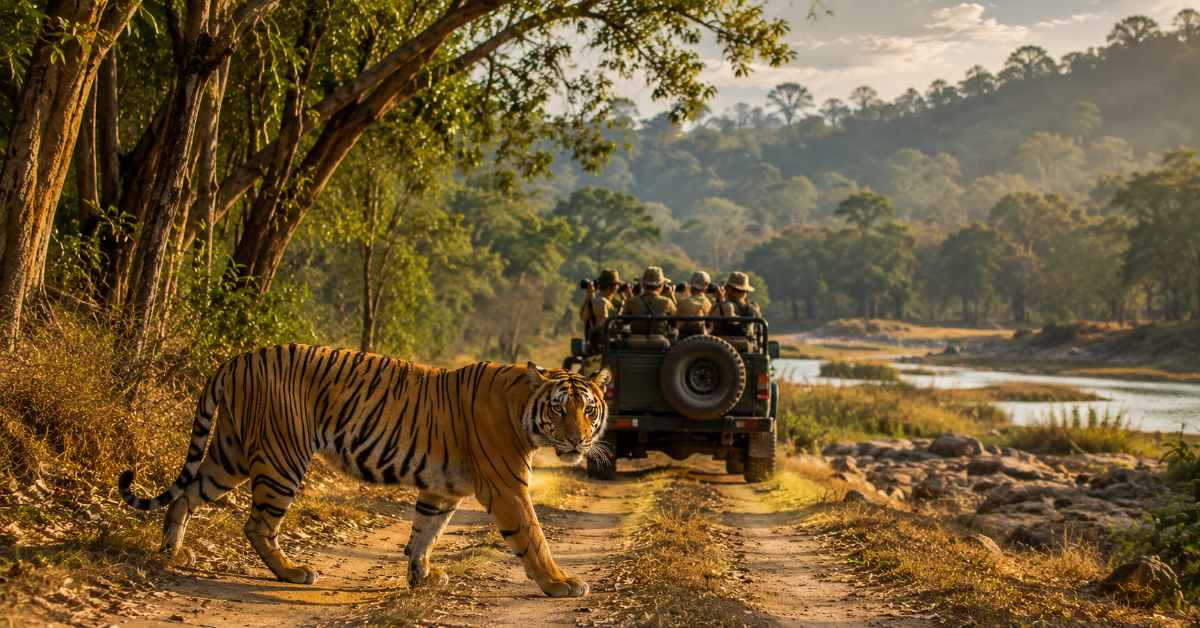
India holds the largest wild Bengal tiger population on the planet, and that’s exactly why tiger safaris here draw wildlife lovers from everywhere. The tricky part isn’t finding a good park, it’s picking the right one for what you actually want, guaranteed sightings, dramatic scenery, or somewhere quieter. Here’s the best tiger safari parks in India, broken down by what each one does best.
Quick Comparison
| Park | State | Tiger Population | Best For |
|---|---|---|---|
| Bandhavgarh | Madhya Pradesh | ~50+ | Highest sighting odds |
| Ranthambore | Rajasthan | ~63 | Dramatic ruins and landscape |
| Jim Corbett | Uttarakhand | 215+ | Elephants, oldest park, biggest area |
| Kanha | Madhya Pradesh | ~125 | Meadows, Jungle Book scenery |
| Pench | Madhya Pradesh | Moderate | Fewer crowds, still reliable |
| Tadoba | Maharashtra | Moderate-high | Strong sightings, less famous |
| Satpura | Madhya Pradesh | Lower density | Walking safaris, quiet forests |
Bandhavgarh: The Best Odds of Seeing a Tiger
If spotting a tiger is your only goal, Bandhavgarh National Park is where most experienced safari guides send people. It has one of the highest tiger densities in the country, and its core zone, at roughly 453 sq km, is far more compact than parks like Corbett or Kanha, which cross 1,000 sq km. That combination of density and compact territory is exactly why sightings here are more consistent than almost anywhere else in India.
Beyond tigers, Bandhavgarh is also home to Indian gaur, the world’s largest bovine, plus sloth bears, leopards, and a solid range of deer species. Ancient ruins around Bandhavgarh Fort add a scenic backdrop to the whole experience.
Ranthambore: Tigers Against Ancient Ruins
Ranthambore National Park combines high tiger sightings with genuinely dramatic scenery, crumbling forts, dry forest, and rocky terrain that create some of the most photogenic safari backdrops in India. It’s also one of the easier parks to reach, which is why it’s frequently paired with the Golden Triangle circuit of Delhi, Agra, and Jaipur for first-time visitors.
With around 63 tigers, it consistently ranks near the top for both sighting probability and overall visual drama.
Jim Corbett: India’s Oldest and Most Complete Park
Established in 1936 as Hailey National Park, Jim Corbett National Park holds the title of India’s oldest national park and was also the birthplace of Project Tiger in 1973. It carries the largest tiger population of any park on this list, over 215, though that population spreads across a much larger area, so sightings can feel less concentrated than at a smaller park like Bandhavgarh.
What Corbett does better than anywhere else is the overall wildlife experience. It’s also the best park in India for Asian elephant encounters, and its safari zones, Dhikala, Bijrani, Jhirna, Dhela, and Durga Devi, each offer a distinct landscape. Dhikala is the standout, since it’s the only zone offering overnight stays inside the park itself.
Kanha: Meadows and Jungle Book Scenery
Kanha National Park’s vast meadows, sal forests, and bamboo groves are often credited as the inspiration behind Rudyard Kipling’s The Jungle Book, and the scenery genuinely earns that reputation. Beyond its roughly 125 tigers, Kanha is known for successfully protecting the hard-ground barasingha, a rare swamp deer species that exists almost nowhere else.
Pench and Tadoba: The Quieter High-Performers
Pench doesn’t carry the name recognition of Bandhavgarh or Ranthambore, and that’s precisely its appeal, strong sightings without the crowds that come with fame. Tadoba, in Maharashtra, follows a similar pattern, less internationally known but consistently ranked highly for sighting reliability by experienced safari guides.
Both are worth considering if you want a genuine tiger safari experience without competing for jeep space at the more famous gates.
Satpura: For a Different Kind of Safari
Satpura is the least crowded major reserve on this list and the only one that regularly offers walking safaris, a genuinely different way to experience the forest compared to a jeep. Spread across roughly 2,200 sq km with teak forests, rocky terrain, and backwaters, it’s been nominated for UNESCO Natural World Heritage status. Tiger density here is lower than at Bandhavgarh or Ranthambore, so it suits travelers who value the overall wilderness experience as much as the tiger sighting itself.
Choosing the Right Park for You
- Want the best odds of seeing a tiger? Bandhavgarh
- Want dramatic scenery alongside good sightings? Ranthambore
- Want the fullest wildlife experience, including elephants? Jim Corbett
- Want classic, open meadow landscapes? Kanha
- Want strong sightings without the crowds? Pench or Tadoba
- Want a quieter, walking-safari experience? Satpura
Booking Tips
Zone permits at the most popular parks, especially core zones at Bandhavgarh and Ranthambore, fill up months in advance. A last-minute booking usually means settling for a buffer zone slot, which comes with noticeably lower sighting chances. If your travel dates are fixed, book as early as you reasonably can, particularly for peak season between November and April.
Bringing It Together
There’s no universally best tiger safari park in India, only the one that matches what you’re after. Bandhavgarh wins on pure sighting odds, Ranthambore on scenery, Corbett on overall wildlife variety, and Pench, Tadoba, or Satpura if you’d rather skip the crowds. Whichever you choose, book your zone early and go in with realistic expectations, since even the best parks can’t guarantee a sighting on any single safari.
FAQs
Which national park has the highest chance of seeing a tiger in India? Bandhavgarh is widely considered the best bet, thanks to its high tiger density packed into a relatively compact core zone.
Which is the best tiger safari park for beginners? Ranthambore is often recommended for first-timers, since it combines strong sightings with easy access from Delhi, Agra, and Jaipur.
Which park has the most tigers overall? Jim Corbett has the largest tiger population of any park in India, with over 215 tigers, though spread across a much larger area than parks like Bandhavgarh.
When is the best time for a tiger safari in India? November through April generally offers the best conditions, with pleasant weather and better visibility, though some zones like Corbett’s Dhikala close during monsoon.