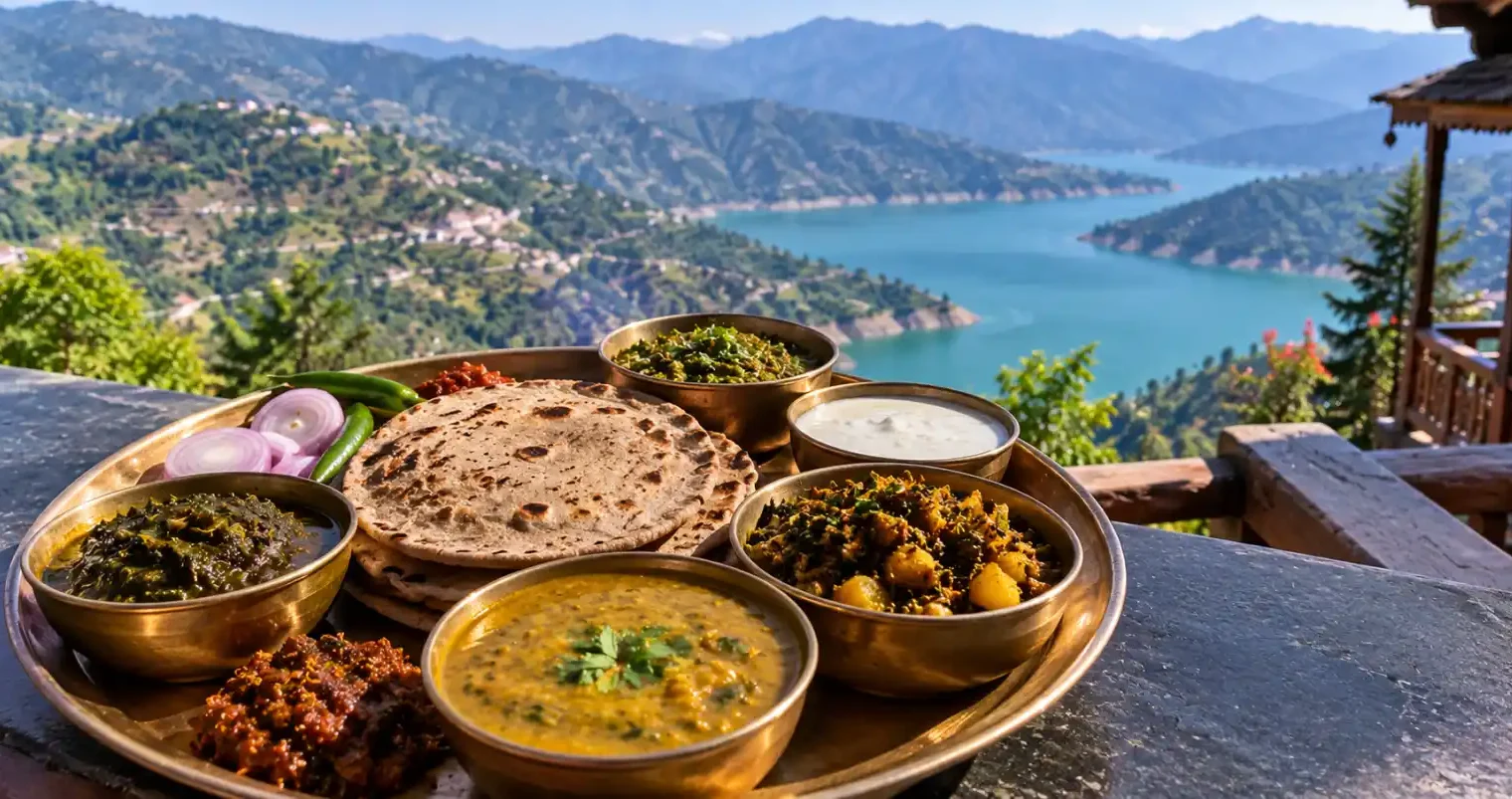
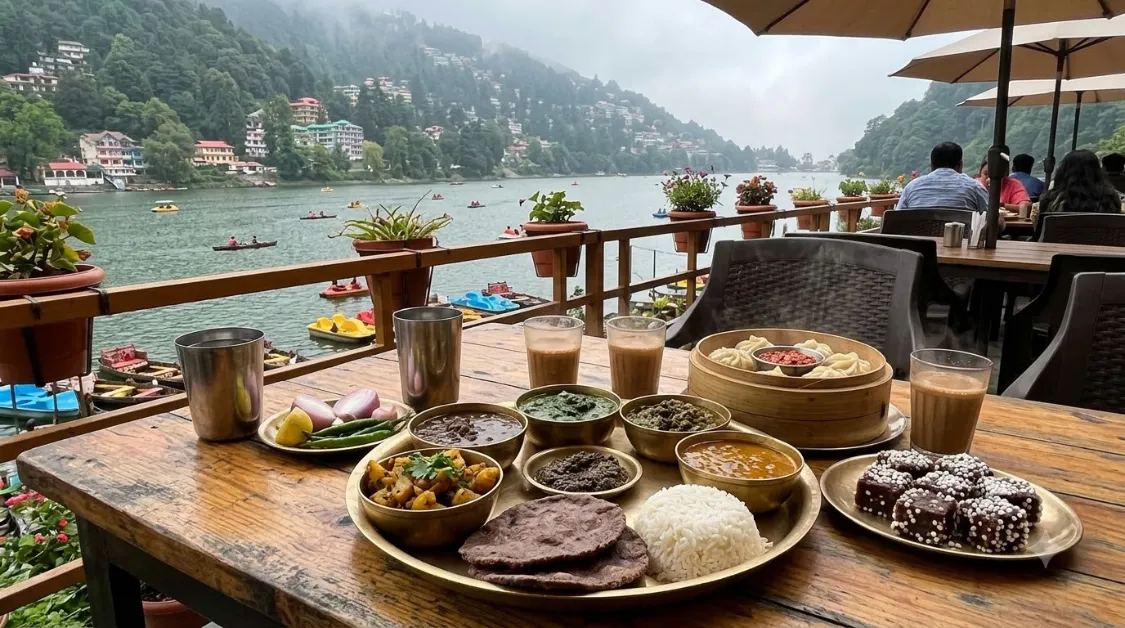
Quick answer: If you want Kumaoni food in Nainital, start with bhatt ki churkani, aloo ke gutke, chainsoo, kafuli, bhang ki chutney, jhangora ki kheer and bal mithai. The easiest way to taste many in one meal is a Kumaoni thali on Mall Road. One local food guide puts a thali at about ₹150 to ₹250. Many places don’t print these dishes on the main menu, so ask for them.
| Dish | What it is | Taste | Try it with |
|---|---|---|---|
| Bhatt ki churkani | Black soybean curry thickened with rice flour | Earthy, mild | Steamed rice |
| Aloo ke gutke | Potatoes tossed with red chillies and mountain herbs | Spicy, crisp | Chai and bhang ki chutney |
| Chainsoo | Roasted, ground black gram dal cooked in ghee | Smoky, rich | Steamed rice |
| Kafuli | Leafy greens like spinach and fenugreek, thickened with rice flour | Fresh, mild | Rice or roti |
| Dubke | Soaked bhatt or gahat dal, ground coarse and cooked | Hearty | Rice or roti |
| Ras | Thin broth from mixed mountain pulses | Warm, light | Rice |
| Kumaoni raita | Curd with cucumber, roasted mustard and cumin | Cool, tangy | Any thali |
| Bhang ki chutney | Roasted hemp seeds ground with chillies and lemon | Tangy, nutty | Aloo ke gutke |
| Mandua ki roti | Flatbread from finger millet (ragi) flour | Dense, nutty | Bhatt dal |
| Jhangora ki kheer | Barnyard millet pudding cooked in milk | Sweet, creamy | After dinner |
| Bal mithai | Dark brown khoya fudge coated in sugar balls | Caramel sweet | As a gift or dessert |
| Singori | Khoya sweet wrapped in a leaf | Milky, light | As a snack |
Now imagine this. You and your family have just reached Nainital after a long climb. Your hands are cold. The lake looks soft in the evening light. Someone says, “Let’s just get noodles.”
Stop right there. A plate of hot aloo ke gutke and a cup of chai will taste a lot better at this height. And a bowl of rice with churkani will feel like someone cooked it for you at home.
That’s what Kumaoni food does. It’s simple, warm and a little surprising. This guide to Kumaoni food in Nainital lists the famous Kumaoni dishes you must try in Nainital, explains each in plain words, and tells you where and how to order them.
What Makes Kumaoni Food in Nainital Different?
Kumaoni food is simple mountain cooking. It leans on local pulses, millets and a few spices, and it uses very little tomato. That’s why it tastes different from the North Indian food you get on the plains. A food guide on Kumaon says the cuisine runs on pulses like bhatt and gahat, and on mustard and cumin more than on heat.
Here’s what that means on your plate:
- Pulses first. Bhatt (black soybean) and gahat (horse gram) show up in curries, fritters and thick pastes.
- Millets, not just wheat. Mandua and jhangora turn up in rotis and desserts.
- Gentle spice. Mustard and cumin give flavour without burning your mouth.
- Seasonal cooking. The same guide says the food changes with the weather, so winter dishes are heavier and warmer.
If you’re used to spicy restaurant curries, this will feel calmer. Many first-timers like that.
Which Kumaoni Main Dishes Should You Order in Nainital?
Order bhatt ki churkani, chainsoo, kafuli and dubke first. They are the heart of a Kumaoni meal, and they pair well with plain rice. Ras is a good next pick, especially in cold months.
Bhatt ki churkani. This is black soybean cooked with rice flour, ginger, garlic and turmeric. The rice flour makes it thick and creamy, and it’s best with rice, per a Kumaon dish guide. Honest opinion? If you only order one thing, make it this.
Chainsoo. Black gram (urad) dal is roasted until it smells fragrant, ground, and cooked in ghee with onion and spices. The same guide says you eat it with steamed rice. It’s a winter favourite but available year-round.
Kafuli. Think of thick, green, comforting leafy curry. It uses greens like spinach and fenugreek and gets its body from rice flour. One food guide calls it Uttarakhand’s state food.
Dubke. Bhatt or gahat is soaked overnight and ground into a coarse paste, then cooked with cumin, fenugreek seeds and garlic. It’s a winter dish, and most people eat it with rice.
Ras. Several pulses, such as chana, bhatt, rajma and gahat, are boiled and the thin broth is separated. You get a warm, light bowl to pour over rice.
Ask for a plain steamed rice on the side. Almost all of these dishes are built around it.
Which Snacks, Sides and Chutneys Are Worth Trying?
Start with aloo ke gutke, a plate of spiced potatoes. Then add Kumaoni raita and bhang ki chutney as sides. Mandua ki roti is a good bread to try if you want something different from plain roti.
Aloo ke gutke. One food guide calls it “the fast food of Kumaon.” It’s potatoes tossed with red chillies and local herbs, and you can find it at tea stalls. Another source ties it to Holi, but you can eat it any day.
Kumaoni raita. This isn’t plain curd. Cucumber is grated into curd, and roasted mustard and cumin seeds are ground coarse and stirred in, as a recipe page explains. The result is cool, sharp and a little nutty. It softens a spicy plate.
Bhang ki chutney. The base is roasted hemp seeds, ground with green chillies, lemon and herbs. It tastes tangy and nutty. People often pair it with aloo ke gutke and thalis.
Mandua ki roti. This flatbread uses ragi (finger millet) flour. Some versions mix in grated carrot, green chilli or spring onion. It’s the classic partner for bhatt dal.
A small tip. Tell the server you want the chutney on the side if you’re not sure about the tang.
Which Kumaoni Sweets Should You Taste in Nainital?
Bal mithai is the one to carry home. Singori is a light snack you can eat on a walk. Jhangora ki kheer is the one for dessert at a sit-down meal.
Bal mithai. It’s a dark brown fudge made by cooking khoya with sugar until it turns deep brown. Each piece is then rolled in tiny sugar-coated white balls. Wikipedia says the sweet began in Almora in the early 1900s, and the sugar balls are made from roasted poppy seeds. Nainital shops sell it too, and one local guide calls it the town’s most famous food.
Singori. It’s a milk-based sweet made with khoya and wrapped in a leaf, which gives it a faint fragrance. Guides name it as a leaf from the maalu plant. Unwrap it slowly.
Jhangora ki kheer. This is a pudding made from barnyard millet cooked in milk. A Kumaon food guide adds kewra and raisins to the list.
Prices vary. The local food guide above puts bal mithai at ₹400 to ₹600 a kg and singori at ₹20 to ₹40 a piece, so check at the counter before you buy.
Where Can You Eat Kumaoni Food in Nainital?
Mall Road and the side lanes around it are the easiest places to find Kumaoni dishes. One local guide names Saket and Embassy on Mall Road as places serving a Kumaoni thali. Small dhabas in side lanes also serve pahadi thalis at modest prices.
Here’s how to plan it:
- Mall Road restaurants. Embassy is also listed by the Incredible India tourism page as a Mall Road restaurant with Indian dishes. A Kumaoni thali there, per the local guide, can include churkani, kafuli, phaanu and gahat ke parathe.
- Side-lane dhabas. Another food guide points to small lane dhabas for pahadi thalis and Mall Road alleys for snacks and sweets.
- Tea stalls. Aloo ke gutke is a tea-stall snack, so keep an eye out near the lake.
- Sweet shops. For bal mithai and singori, pick a counter where you can see the sweets, and ask for a small taste if they allow it.
A word of caution. Menus change, and many restaurants here lean towards Chinese and North Indian food. A February 2026 restaurant guide says to ask staff for Kumaoni options, because the dishes may not be on the main menu. It also suggests one local main plus familiar sides for your first try.
Staying near the lake makes all of this easier. If you haven’t booked yet, read about budget hotels in Nainital first, so you know which side of town you’ll walk from.
How Much Does Kumaoni Food in Nainital Cost?
A Kumaoni thali costs about ₹150 to ₹250 in one local guide. A sit-down Kumaoni meal for two falls between ₹600 and ₹1,400, per a separate restaurant guide. Sweets are cheap by weight. Prices change, so treat these as a rough idea.
| What | Rough price | Source type |
|---|---|---|
| Kumaoni thali | ₹150 to ₹250 | Local food guide |
| Meal for two (Kumaoni dishes) | ₹600 to ₹1,400 | Restaurant guide |
| Bal mithai | ₹400 to ₹600 per kg | Local food guide |
| Singori | ₹20 to ₹40 per piece | Local food guide |
Ask for the price before you order a thali with extras. And for sweets, ask the rate per kg before the shopkeeper starts packing.
When Is the Best Time to Eat These Dishes?
Winter and late autumn are the best months for heavy Kumaoni dishes. Chainsoo, dubke and ras are described as winter foods in one Kumaon dish guide, though they are served year-round. Summer is better for raita, chutney and sweets.
If you’re visiting between October and early spring, order the hot, pulse-heavy dishes. They suit the cold. In the warmer months, lean on a thali with raita and a lighter main. The weather here changes fast, so a hot bowl of dal often feels right even in May evenings.
Want a walk before dinner? Plan it around places to see around the lake, then head to Mall Road when the lights come on.
How Can You Plan One Day of Kumaoni Food in Nainital?
Spread the dishes across the day and you won’t feel stuffed. Here’s an easy plan for Kumaoni food in Nainital, built only from dishes covered above.
- Morning or tea time: A cup of chai with a plate of aloo ke gutke and a spoon of bhang ki chutney.
- Lunch: A Kumaoni thali on Mall Road. Look for churkani, kafuli, raita and rice, plus gahat ke parathe if they have them.
- Evening walk: A singori from a sweet counter while you stroll by the water.
- Dinner: Chainsoo or dubke with steamed rice, and jhangora ki kheer to finish.
- Before you leave: A small box of bal mithai for home.
That’s five stops and nothing heavy. If you’re staying a second day, repeat the thali but swap the main dish.
Can Vegetarians Enjoy Kumaoni Food in Nainital?
Yes. Most dishes in this guide are built from pulses, greens, potatoes, millets and milk sweets, so vegetarians have plenty to order. Churkani, chainsoo, kafuli, dubke, raita, gutke and all the sweets above fit that description. Ask the server to confirm how a dish is cooked if you follow a strict diet.
Tips for Trying Kumaoni Food in Nainital for the First Time
Keep it simple on your first order. Pick one main, one side and one sweet. Share with your family so you can taste more without wasting food.
- Say “pahadi thali” or “Kumaoni thali” when you sit down. It’s the quickest route to several dishes.
- Ask which dishes are made fresh today. Some, like dubke, need overnight soaking.
- Order rice with dal-based dishes. Most guides list it as the usual partner.
- Keep bhang ki chutney on the side if you don’t like sharp flavours.
- Ask the price first at small stalls and sweet counters.
- Buy bal mithai at the end of your trip, so you’re not carrying it around all day.
Not sure what to pick? Here’s a quick way to decide. If you like mild food, go for kafuli and raita. If you like spice, go for aloo ke gutke with chutney. If you want one memory to take home, buy a small box of bal mithai.
FAQs About Kumaoni Food in Nainital
What is Kumaoni food?
Kumaoni food is the traditional cooking of the Kumaon region of Uttarakhand. It uses local pulses like bhatt and gahat, millets like mandua and jhangora, and simple spices like mustard and cumin. It uses little tomato and is usually mild, warm and filling.
What are the famous Kumaoni dishes to try in Nainital?
Famous Kumaoni dishes to try in Nainital include bhatt ki churkani, aloo ke gutke, chainsoo, kafuli, dubke, Kumaoni raita and bhang ki chutney. For sweets, try bal mithai, singori and jhangora ki kheer. A Kumaoni thali lets you taste several in one meal.
Where can I eat Kumaoni food in Nainital?
You can find Kumaoni food around Mall Road. A local guide names Saket and Embassy as places serving a Kumaoni thali, and side-lane dhabas serve pahadi thalis too. Menus change, so ask staff if Kumaoni dishes are available and what is made fresh today.
Is Kumaoni food spicy?
Kumaoni food is usually mild to medium. It relies on mustard, cumin and local herbs more than on heavy chilli. Some dishes, like aloo ke gutke, use red chillies and can taste sharp, but most main dishes are gentle and best eaten with steamed rice.
Which sweet is Nainital famous for?
Bal mithai is the sweet most visitors take home from Nainital. It is a dark brown khoya fudge coated in sugar balls and began in nearby Almora. Singori, a khoya sweet wrapped in a leaf, is another local favourite and costs far less per piece.
How much does Kumaoni food cost in Nainital?
A Kumaoni thali costs about ₹150 to ₹250 in one local guide, and a meal for two with Kumaoni dishes falls between ₹600 and ₹1,400 in another. Bal mithai runs about ₹400 to ₹600 a kg. Prices change, so confirm before ordering.
Start with One Thali, Then Follow Your Taste
Good Kumaoni food in Nainital isn’t hard to find. You just have to ask for it. Start with a thali on Mall Road, add a plate of aloo ke gutke at a tea stall, and finish with a small box of bal mithai.
Keep rice on the table, go easy on the chutney, and let the cold evening do the rest.