
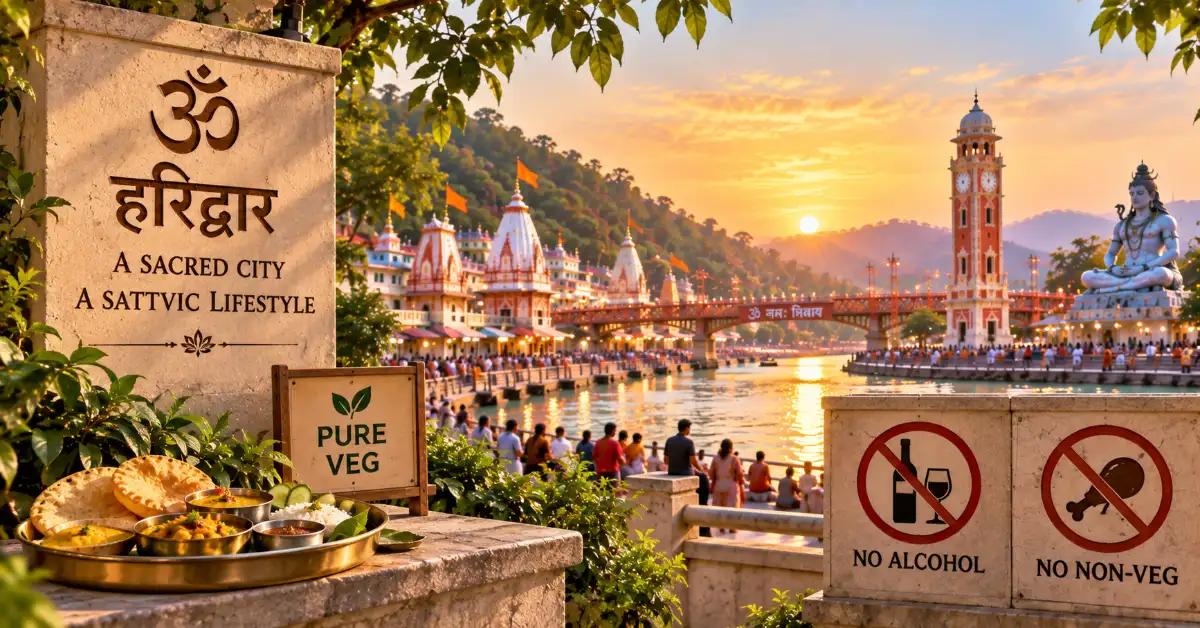
Quick Answer: Haridwar is a legally recognized vegetarian city, not just a cultural custom. In 2004, the Supreme Court upheld a Uttarakhand government decision banning the public sale of meat, fish, and eggs within Haridwar, based on its status as one of Hinduism’s holiest pilgrimage cities. Alcohol is similarly prohibited through municipal bylaws. Both bans exist to preserve the religious sanctity of the Ganga and the city’s role as a center of pilgrimage.
If you’re wondering why is Haridwar vegetarian while most of India isn’t, the short answer is that it’s not simply tradition, it’s backed by an actual legal ruling. Here’s the real story behind it, and why it’s not unique to Haridwar either.
The Legal Basis: A 2004 Supreme Court Ruling
This is the part that surprises a lot of visitors. Haridwar’s vegetarian status isn’t just informal custom, it’s grounded in law. In 2004, the Supreme Court upheld a decision by the Uttarakhand government to make Haridwar a pure vegetarian city, formally banning the public trade of meat, fish, and eggs within its limits. This isn’t a state-wide rule either. Uttarakhand as a whole has no blanket prohibition on non-vegetarian food or alcohol, the restriction applies specifically to designated holy cities like Haridwar and Rishikesh.
No Alcohol Allowed in Haridwar: Why It’s Enforced
Alcohol sale and consumption in Haridwar is restricted through municipal bylaws rather than a single sweeping state law, reinforced specifically around the Ganga ghats. This became publicly visible in 2021, when local priests and the Ganga Sabha, the body managing Har Ki Pauri, objected to a Bollywood film that had shown scenes of alcohol and non-vegetarian food consumption along the ghats. The city’s mayor at the time cited municipal bylaws explicitly prohibiting both, particularly on the ghats themselves, confirming this isn’t just social pressure but an actual enforced rule.
The Reason Haridwar Has No Non Veg Food
The reasoning ties directly to what Haridwar represents. The name itself translates roughly to “Gateway to God,” and the city is considered one of the seven holiest places in Hinduism, the point where the Ganga leaves the Himalayas and enters the plains. For a city built entirely around pilgrimage, ritual bathing, and the sanctity of the river, allowing meat sale or alcohol consumption is seen as directly conflicting with that religious purpose.
Haridwar Religious Food Rules Explained: Not a One-Off Case
Haridwar isn’t alone in this. Several other Indian pilgrimage cities follow similar rules, which puts the restriction in useful context:
- Rishikesh: Uttarakhand’s other major holy city, following the same vegetarian and alcohol-free pattern
- Varanasi: A 250-meter ban on alcohol and non-vegetarian food around temples and heritage sites
- Vrindavan and Mathura: Both enforce similar restrictions tied to their association with Lord Krishna
- Pushkar, Rajasthan: A complete ban on both meat and alcohol, tied to its status as a sacred pilgrimage town
- Ayodhya: Similar restrictions near religious sites, part of a broader pattern across designated “teerth” or pilgrimage zones in India
This pattern reflects a specific legal category some Indian cities and towns fall into, places formally declared sacred or pilgrimage-focused, where local or state governments have moved to restrict meat and alcohol sale as a matter of policy, not just custom.
What This Means for Visitors
In practice, this means you won’t find meat, fish, or eggs sold anywhere within Haridwar’s city limits, and alcohol isn’t available in restaurants, hotels, or shops either. This applies to everyone, residents and tourists alike, regardless of personal dietary habits back home. If this is a firm requirement for your trip, it’s worth knowing well before you arrive, rather than discovering it once you’re already there.
FAQs
Is Haridwar’s vegetarian status a law or just a custom? It’s backed by law. In 2004, the Supreme Court upheld a Uttarakhand government ruling that formally banned the sale of meat, fish, and eggs within Haridwar city limits.
Why is alcohol not allowed in Haridwar? Alcohol is restricted through municipal bylaws tied to the city’s religious significance, particularly enforced around the Ganga ghats, to preserve the sanctity of this major pilgrimage site.
Is the vegetarian rule specific to Haridwar, or all of Uttarakhand? It’s specific to designated holy cities like Haridwar and Rishikesh. Uttarakhand as a state has no blanket ban on non-vegetarian food or alcohol.
Are other Indian cities also vegetarian and alcohol-free for religious reasons? Yes. Rishikesh, parts of Varanasi, Vrindavan, Mathura, Pushkar, and Ayodhya all have similar restrictions tied to their status as pilgrimage or sacred sites.